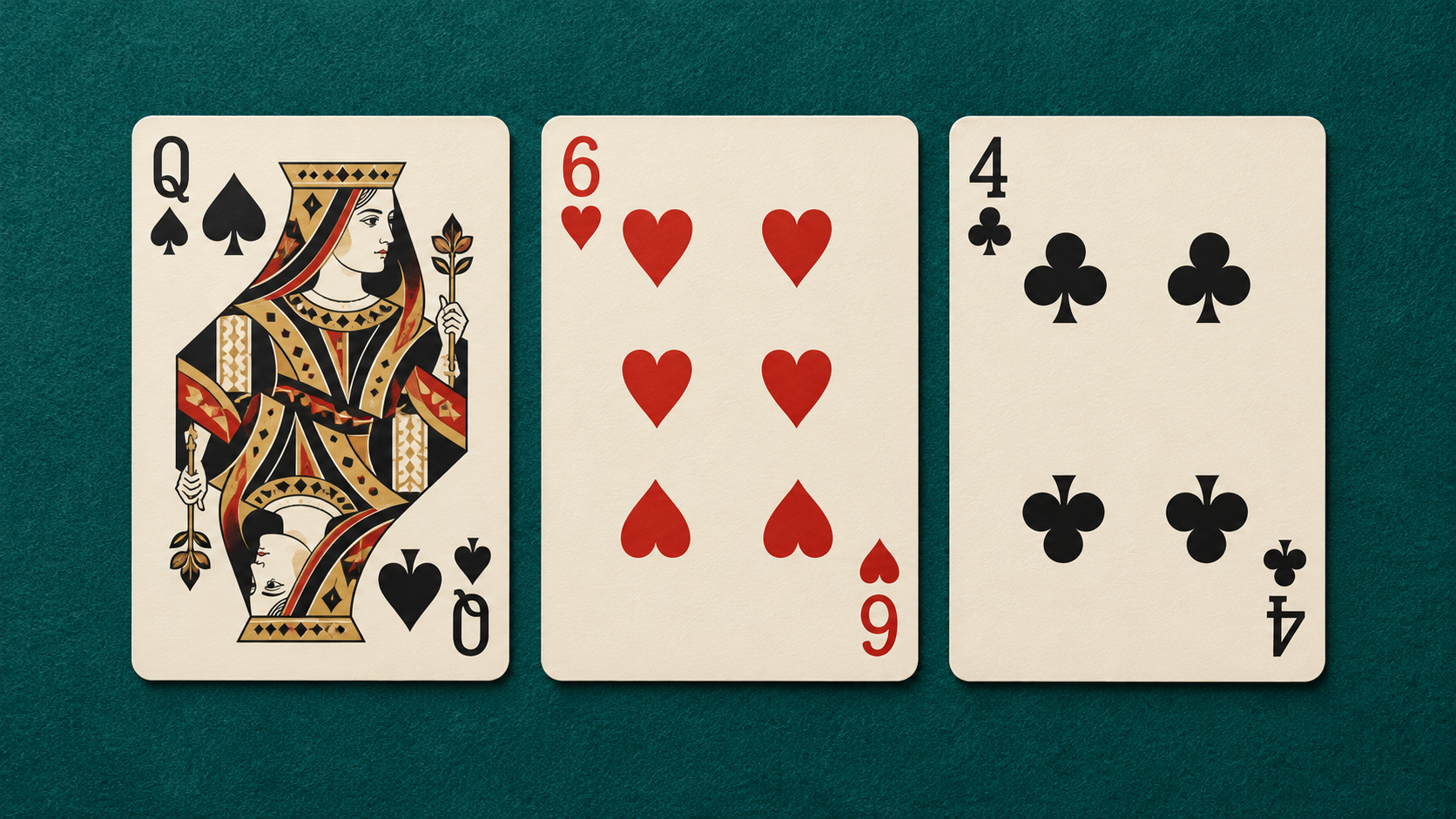
With the Three Card Poker Ante/Play rules used here, play Q-6-4 or a better poker hand and fold a lower hand. That makes Q-7-2 a Play and Q-6-3 a Fold, provided these are ordinary high-card hands—not flushes. Compare the cards in descending order, not by adding their values.
The boundary is stated in Loto-Quebec's published online Three Card Poker rules. Below, we explain the decision and independently calculate three example hands. This is about reducing the expected cost under a specific rule set, not turning the game into a source of income.
Read Q-6-4 as a ranking, not a total
For an unpaired high-card hand, compare the highest card first, then the second, then the third. Q-7-2 beats Q-6-4 because 7 beats 6; the 2 never enters that comparison. Q-6-3 loses to Q-6-4 because their queens and sixes tie, leaving 3 against 4.
| Player's hand | Deciding comparison | Ante/Play decision |
|---|---|---|
| Q♠ 7♥ 2♣ | Second card 7 is above 6 | Play |
| Q♠ 6♥ 4♣ | Exactly the boundary | Play |
| Q♠ 6♥ 3♣ | Third card 3 is below 4 | Fold |
| Q♠ 6♠ 3♠ | This is a flush, not a high-card hand | Play |
A pair or any higher category also outranks the boundary. Three Card Poker has its own category order: straight flush, three of a kind, straight, flush, pair, high card. In particular, a straight beats a flush; do not import five-card poker's order.
What the second stake buys
The scope is a 52-card deck with three cards each for player and dealer. You put down an Ante before seeing the hand. Folding loses that Ante; playing adds a second, equally sized stake. The dealer qualifies with queen-high or better. A non-qualifying dealer pays the Ante at even money and returns the Play stake. A qualifying dealer compares hands; a player win pays both at even money, a loss loses both, and a tie returns both.
Here is the complete accounting for a €10 Ante and Q♠ 7♥ 2♣. If you play, the combined stake is €20. The example hand earns no Ante Bonus.
| Decision or dealer result | Total staked | Total returned, including stakes | Net result |
|---|---|---|---|
| Fold immediately | €10 | €0 | −€10 |
| Play; dealer J♣ 9♦ 4♠ does not qualify | €20 | €30 | +€10 |
| Play; dealer Q♣ 6♦ 5♥ qualifies and loses | €20 | €40 | +€20 |
| Play; dealer K♣ 8♦ 3♥ wins | €20 | €0 | −€20 |
| Play; dealer Q♣ 7♦ 2♥ ties | €20 | €20 | €0 |
A €30 return on €20 committed is €10 of profit, not €30. That difference is essential when comparing the Play decision with losing only the Ante.
Why playing can be less costly even with a negative expectation
Once the Ante is down, folding is not a zero-cost alternative: it fixes a loss of one Ante. A Play decision can be preferable even when its average net result is still negative. The question is which option has the less negative expectation, not whether either guarantees profit.
For each of the three rainbow hands below, we removed the player's cards and enumerated every unordered dealer hand from the remaining 49 cards: 49 × 48 × 47 ÷ 6 = 18,424 equally likely combinations. No other cards are known. With one Ante as the unit, Play returns a net +1 when the dealer does not qualify, +2 for a qualifying dealer loss, −2 for a dealer win, and 0 for a tie. These high-card player hands cannot earn the additional Ante Bonus.
| Player hand | Dealer does not qualify | Player wins against qualified dealer | Player loses | Ties | Average net if played |
|---|---|---|---|---|---|
| Q♠ 6♥ 4♣ | 5,758 | 305 | 12,335 | 26 | −0.993378 Antes |
| Q♠ 6♥ 3♣ | 5,747 | 271 | 12,380 | 26 | −1.002551 Antes |
| Q♠ 7♥ 2♣ | 5,732 | 406 | 12,260 | 26 | −0.975684 Antes |
For Q♠ 6♥ 4♣, the calculation is (5,758 + 2 × 305 − 2 × 12,335) ÷ 18,424 = −0.993378. That is slightly better than folding for −1. For Q♠ 6♥ 3♣, playing averages −1.002551, slightly worse than folding. Q♠ 7♥ 2♣ averages −0.975684, so Play is preferable there.
These are conditional expectations for those exact cards, not the game's overall house edge or a forecast of your next session. Changing the suits changes which dealer flushes remain possible and changes the exact counts. Checking the non-flush suit patterns for these three rank combinations preserved their Play/Fold decisions; it did not make the numerical expectations identical.
The boundary does not answer every betting question
The operator's separate table-game rules also distinguish the Ante Bonus from Pair Plus. A stronger player hand can earn an Ante Bonus independently of the dealer comparison, while Pair Plus is a separate wager on the player's cards. Neither is included in our three high-card calculations, and a Q-6-4 decision rule is not advice to add side bets.
Before choosing a table through CasinOK, identify its actual qualification rule, payouts and extra wagers. This guide does not certify that every version follows the cited operator's configuration.
Budget for the possible Play stake before placing the Ante. A mathematically preferable continuation can still lose both bets immediately. If the additional stake would exceed your limit, stop rather than increase that limit to follow a chart; the next session's initial stake should leave room for the game's normal decisions. Previous losses do not change the next freshly dealt hand's prospects.