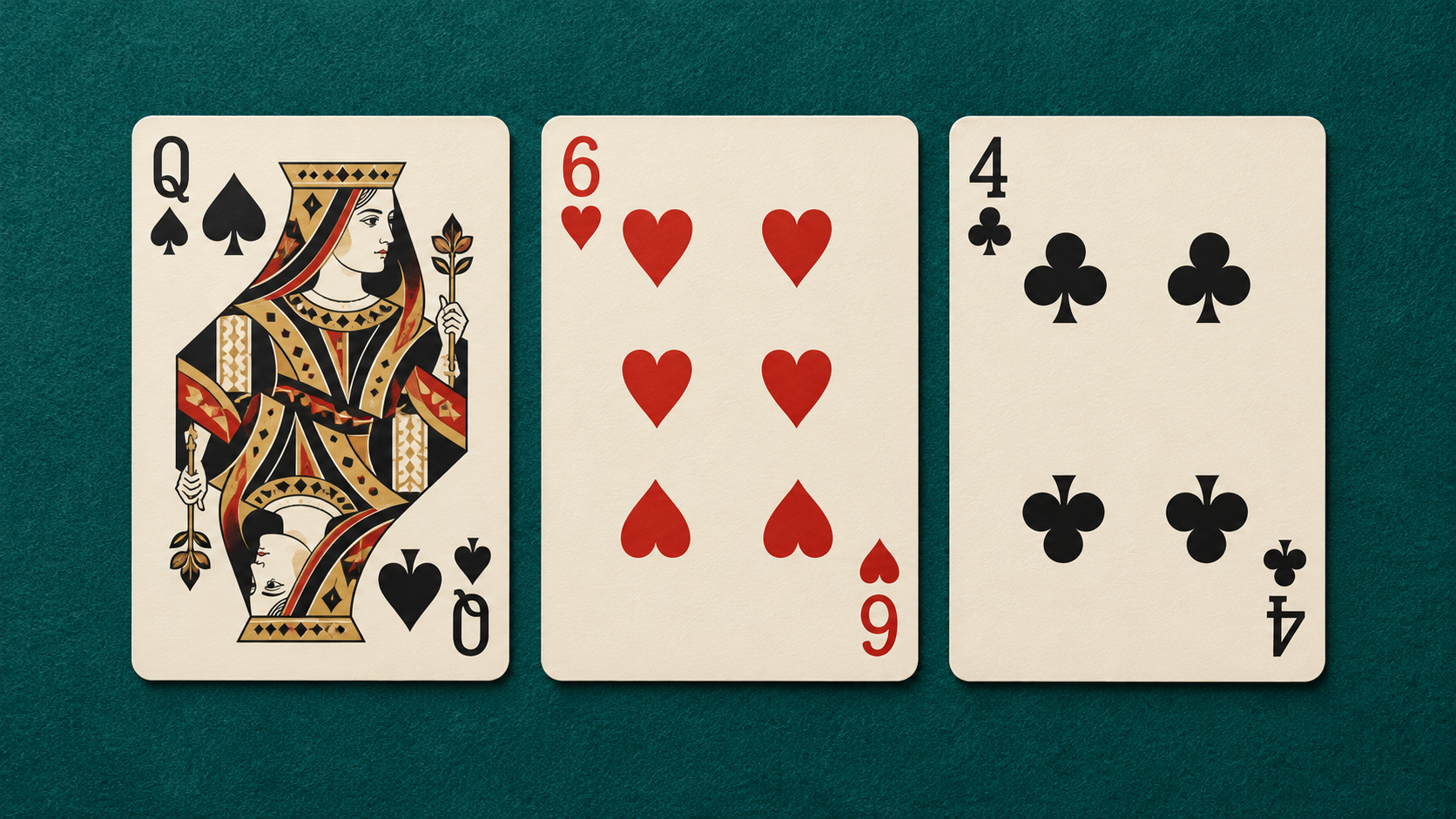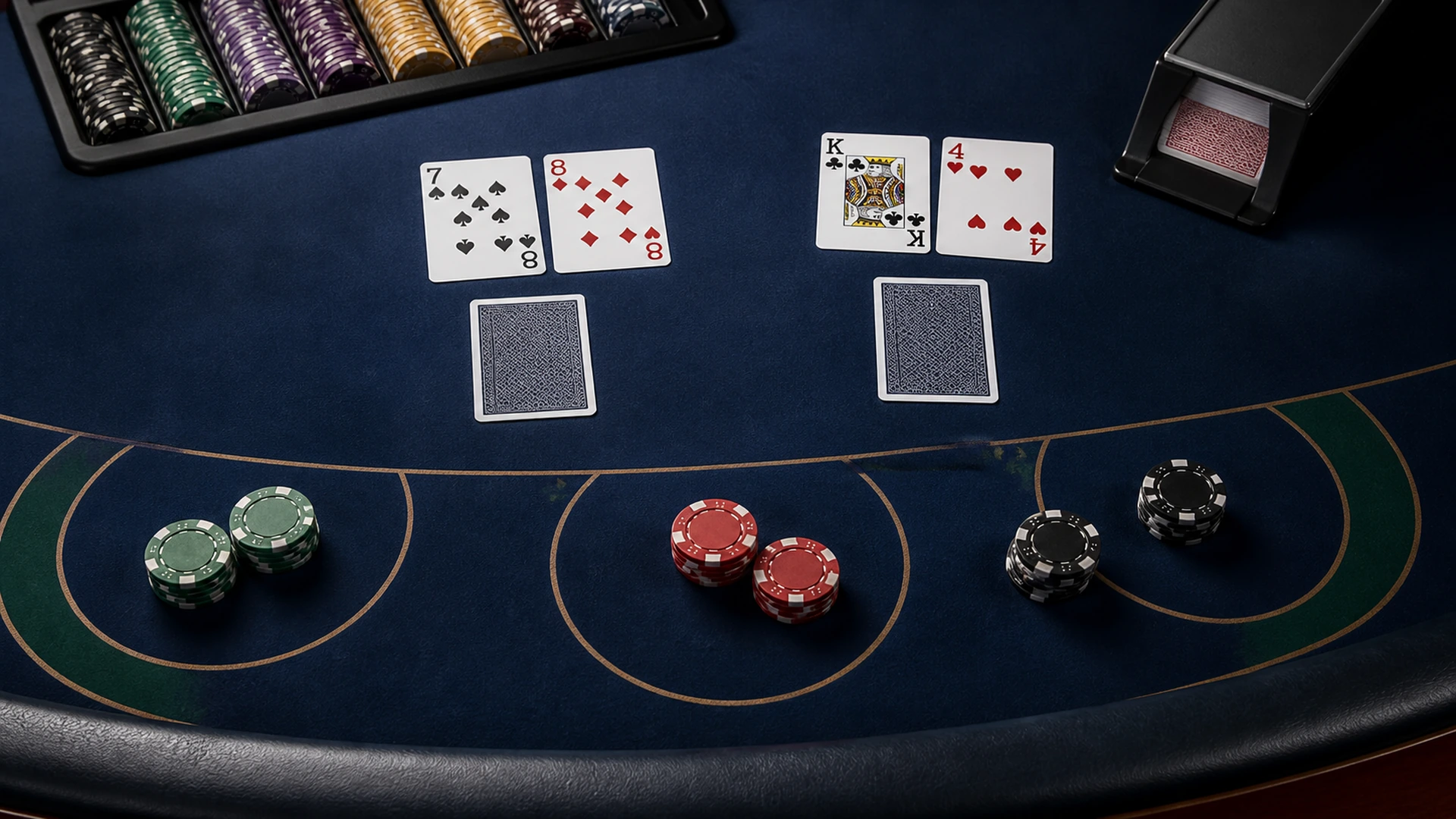
Betting equal amounts on Big and Small in Sic Bo does not create a break-even strategy. With the 1:1 payouts and triple exclusion examined here, a non-triple returns your combined stake; any triple loses both bets. There is no outcome that leaves a profit from that pair of wagers.
Adding an Any Triple bet covers the missing result, but coverage is not the same as getting your money back. Below, complete settlement examples show the difference—including a combination that returns €32 from €33 staked on every valid roll.
The exception that matters more than the totals
Small covers totals from 4 to 10 and Big from 11 to 17, but triples lose on both. Loto-Québec's electronic Sic Bo guide explicitly includes that exception. A roll of 2–2–2 totals 6, yet it is not a Small win. Likewise, 4–4–4 totals 12 but does not win Big.
For the fixed-payout calculations, we use the numbered-dice Option A in Crown Melbourne's published Sic Bo rules, version 6.1: Small and Big pay 1:1, while Any Triple pays 31:1. These are profit odds: a winning €1 Any Triple bet earns €31 and also returns its €1 stake. This is a documented rule set, not a claim about every Sic Bo version or a particular CasinOK table.
Two winning-looking bets, no profitable round
Suppose €10 goes on Small and €10 on Big. The total committed is €20. Count both wagers when assessing the result, not just the box that lights up.
| Dice result | What happens to the wagers | Total returned | Net result |
|---|---|---|---|
| 1–2–3: Small | Small returns €20; Big loses €10 | €20 | €0 |
| 4–5–6: Big | Big returns €20; Small loses €10 | €20 | €0 |
| 2–2–2: triple | Both €10 bets lose | €0 | −€20 |
The €20 paid by a winning side includes that side's original €10. It is not €20 of profit. The other €10 has already been lost, leaving the combined position unchanged on a non-triple.
With three independent fair six-sided dice, there are 6 × 6 × 6 = 216 equally likely ordered rolls. We enumerated them: 105 win Small, 105 win Big, and six are triples, from 1–1–1 through 6–6–6. Thus the pair breaks even on 210 of 216 outcomes and loses €20 on the remaining six.
The expected net result per €20 round is therefore (210 × €0 + 6 × −€20) ÷ 216 = −€0.5556, rounded. That is an expected cost of 2.7778% of the combined amount staked. It is a long-run average under the assumptions, not a prediction that a particular session loses 56 cents per round.
A quieter result is not a cheaper one
For a fair comparison, keep the total stake unchanged. A single €20 Small bet wins €20 on 105 outcomes and loses €20 on 111. Its expectation is (105 × €20 − 111 × €20) ÷ 216 = −€0.5556 too.
The two approaches have the same expected currency cost at that stake, but very different results. The single-side bet can finish the round ahead; the equal opposite bets cannot. The latter replaces frequent wins and losses with many unchanged balances and occasional full €20 losses. A long run of unchanged balances is not evidence that the combination has removed the house edge.
Comparing €10 on Small with €10 on each side would instead double the total stake. The expected loss would rise from about €0.2778 to €0.5556 per round even though the balance changes less often. Do not mistake fewer losing rounds for less money exposed.
Covering the triple can lock in a loss
Under the specified 31:1 Any Triple payout, add €1 on Any Triple to the original €10 on each side. Now €21 is committed. A non-triple returns €20, so the round loses €1. A triple returns €32 from the triple bet and nothing from the other two, producing €11 net profit. The expected result becomes (210 × −€1 + 6 × €11) ÷ 216 = −€0.6667: the extra hedge increases the expected currency loss.
A more revealing counterexample uses €16 on Small, €16 on Big and €1 on Any Triple. This is an accounting demonstration, not a staking recommendation:
| Outcome | Winning wager's total return | Total staked | Combined net |
|---|---|---|---|
| Non-triple Small | €32 from Small | €33 | −€1 |
| Non-triple Big | €32 from Big | €33 | −€1 |
| Any triple | €32 from Any Triple | €33 | −€1 |
Every possible valid dice result makes one box win, yet every result loses €1 overall. The stake ratio has removed uncertainty about the loss, not the loss itself.
Use the whole-round result as your test
When comparing a Sic Bo table through CasinOK, the useful question is what all your wagers return together after every losing stake is counted. This guide does not confirm any game's availability. Minimum bets, allowed chip increments and restrictions on opposite wagers may also prevent these exact combinations.
The triple-hedge examples require a fixed 31:1 payout. Different payouts or multiplier features need their own calculation; these figures cannot simply be transferred to another variant. All probability calculations assume fair independent dice, without promotions, fees or other rule changes. They are mathematical examples, not results from a test session.
No stake arrangement controls the next roll. If you choose to play, set a total spending limit before placing any wagers and count every added hedge against it. Skipping a round avoids its wagering cost; adding more bets to recover earlier losses does not.