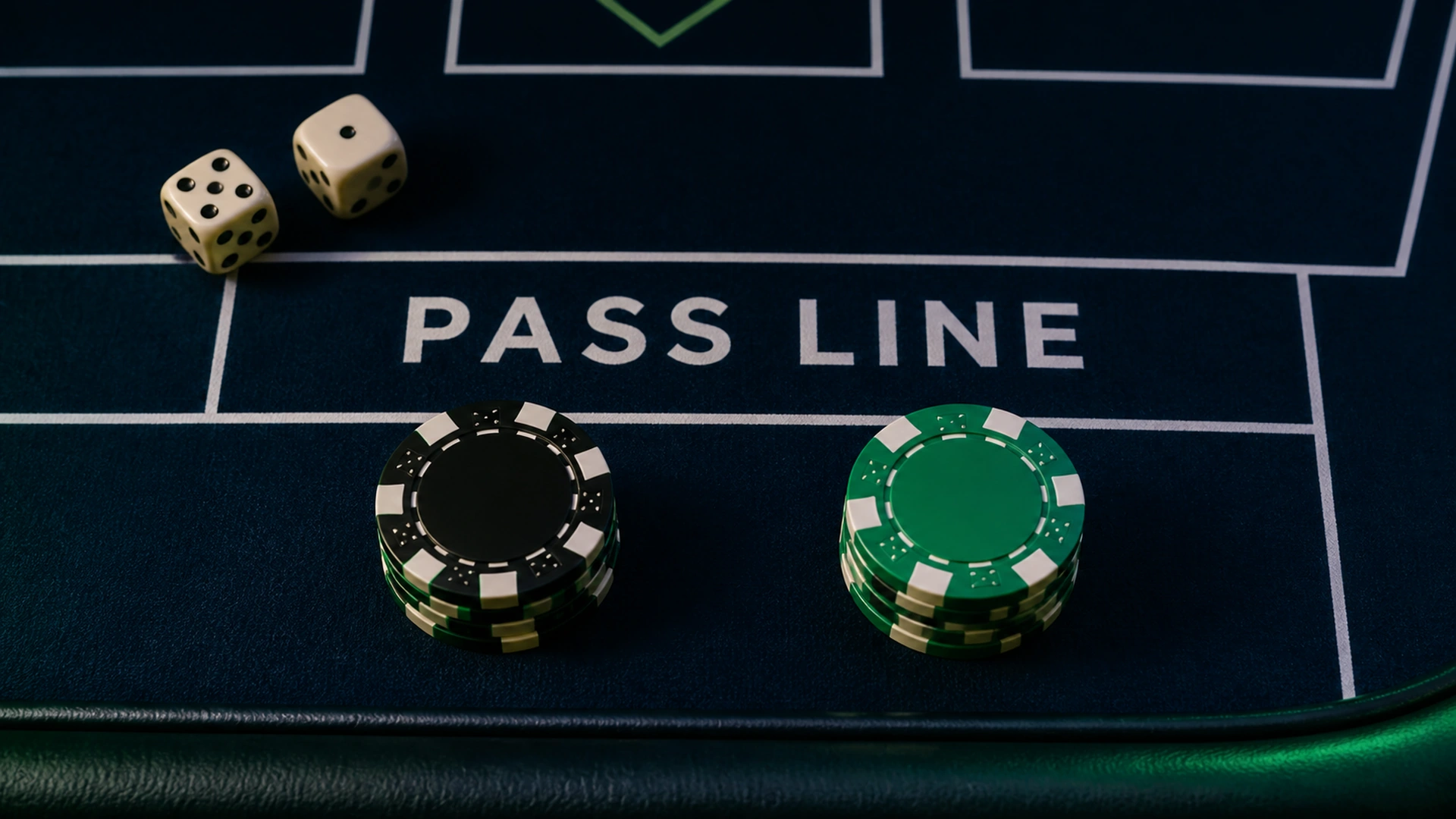
A Pass Line wager is one of the simplest ways to follow a craps round, but the addition of an odds wager creates a distinction that is often explained badly. The odds portion is paid at the true mathematical odds and therefore has no built-in house advantage. That does not make the whole position risk-free, and it does not turn craps into a positive-expectation game. It means the expected casino margin is attached to the original Pass Line stake while the additional odds money increases the amount exposed to short-term swings.
How a Pass Line round works
The first roll is the come-out roll. A total of 7 or 11 wins the Pass Line immediately. A total of 2, 3 or 12 loses it. Any 4, 5, 6, 8, 9 or 10 becomes the point. Once a point exists, the wager wins if that point appears again before a 7 and loses if a 7 arrives first. New York's published craps rules provide a useful official description of this sequence and the odds wager that may follow a point.
| Stage | Winning result | Losing result | Other result |
|---|---|---|---|
| Come-out | 7 or 11 | 2, 3 or 12 | 4, 5, 6, 8, 9 or 10 sets the point |
| Point cycle | The point repeats | 7 | Any other total continues the cycle |
Where the 1.414% house edge comes from
Across all possible rounds, the standard Pass Line has a house edge of about 1.414%. The percentage is a long-run expectation applied to the original wager, not a prediction for the next roll or session. A player can finish far above or below that expectation over a small sample because dice outcomes are variable.
The come-out roll slightly favours the Pass Line because there are six combinations for 7 and two for 11, compared with one combination for 2, two for 3 and one for 12. Once a point is established, however, 7 is more likely than every individual point. The weighted combination of those stages produces the house edge.
Why the odds wager is different
After a point is set, a separate odds wager may be placed behind the Pass Line. It pays according to the real probability of making that point before a 7: 2:1 on 4 or 10, 3:2 on 5 or 9, and 6:5 on 6 or 8. Because those payouts match the underlying ratios, the odds portion has a theoretical house edge of zero.
| Point | Ways to roll point | Ways to roll 7 | True-odds payout |
|---|---|---|---|
| 4 or 10 | 3 | 6 | 2:1 |
| 5 or 9 | 4 | 6 | 3:2 |
| 6 or 8 | 5 | 6 | 6:5 |
Zero edge does not mean zero risk. An odds wager can lose in full on the next resolving roll. It also cannot exist independently under standard rules: the player must first make the negative-expectation Pass Line wager.
Combined edge versus expected money lost
Suppose the Pass Line stake is 10 units. Its theoretical expected loss is about 0.1414 units per completed decision. Adding 10 units of single odds does not add theoretical loss to that decision, so the expected loss remains about 0.1414 units while 20 units are now at risk. Expressed as a percentage of total action, the combined edge is about 0.707%. With 20 units of odds, 30 units are exposed and the combined percentage is about 0.471%.
This lower combined percentage is sometimes presented as if risk has fallen. In cash terms, the expected loss on the original line is unchanged, while the range of possible short-session results becomes wider because more money rides on the point. A smaller percentage of a larger amount is not the same as a smaller bankroll swing.
| Position | Total exposed after point | Expected loss from 10-unit line | Combined edge on total action |
|---|---|---|---|
| Pass only | 10 units | 0.1414 units | 1.414% |
| Pass + 1x odds | 20 units | 0.1414 units | About 0.707% |
| Pass + 2x odds | 30 units | 0.1414 units | About 0.471% |
Table limits change the exposure
A 1x table permits odds equal to the line stake. A 2x table permits twice that amount. A common 3-4-5x structure allows three times the line on points 4 or 10, four times on 5 or 9, and five times on 6 or 8. Those amounts are designed so a maximum odds win is consistent across point groups, but the permitted exposure still varies.
The maximum is a limit, not a recommendation. Someone working with a fixed entertainment budget should calculate the largest possible amount tied up in one decision before placing the line wager. If a 10-unit line can be followed by 50 units of odds, the practical exposure is 60 units, not 10.
Bankroll and session context
A sensible risk plan starts with a money limit and a time limit that do not depend on winning anything back. Divide the planned money by the maximum exposure per decision, not merely by the table minimum. This does not improve the mathematical return; it only makes the size of the risk visible.
- Confirm the table's odds limit before the come-out roll.
- Count line and odds money together when measuring exposure.
- Do not increase stakes because several points have failed.
- Do not treat a long run without a 7 as evidence about the next roll.
- Stop at the pre-set money or time boundary.
Common misunderstandings
The shooter cannot change independent dice probabilities through a betting pattern. An odds wager does not erase the original house edge. A lower combined-edge percentage does not guarantee a longer session, because higher odds create larger wins and losses. Finally, historical streaks do not make a point or 7 due.
Academic work on craps also illustrates how easily unusual streaks can be misestimated; the analysis of an exceptionally long hand is useful context for separating memorable outcomes from ordinary probability.
Bottom line
Pass Line odds are mathematically fair as a separate wager, but they increase the amount exposed and the variance of a session. The original Pass Line still carries its 1.414% edge. The useful decision is therefore not whether odds can beat the house, but whether the full possible exposure fits a fixed entertainment budget. CasinOK Casino presents this material as probability education, and its responsible-gaming guidance should be treated as the boundary for any play.