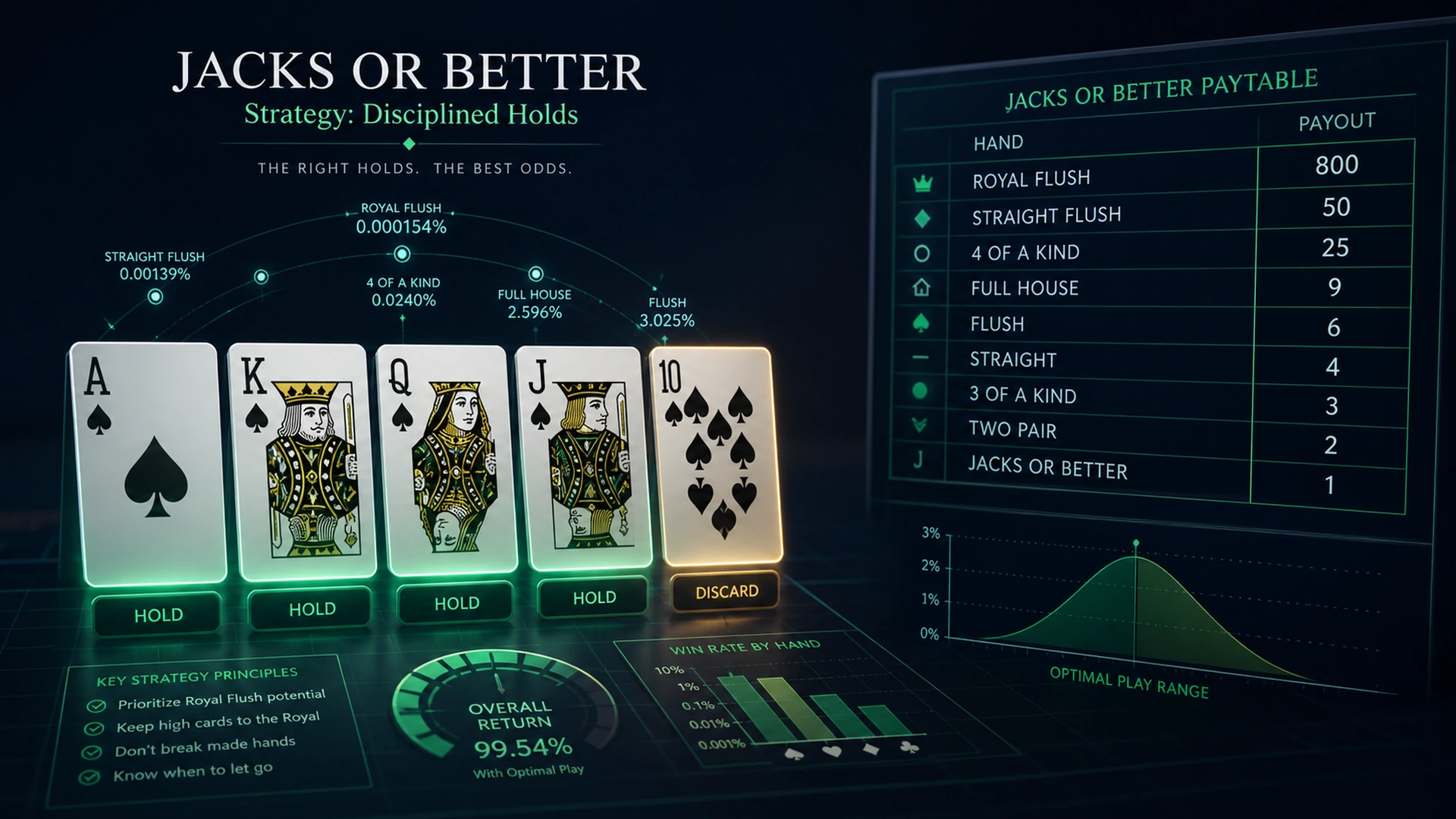
Jacks or Better strategy begins before the deal: read the paytable. Two machines can share the same name while paying different amounts for a full house or flush, which changes both the theoretical return and some borderline hold decisions. The familiar “9/6” version pays 9 coins for a full house and 6 for a flush per coin wagered. Under the complete 9/6 schedule and optimal decisions, published mathematical analysis places the long-run return at about 99.54%. That figure is not a promise for one session; it is an average across a very large number of hands.
Start with the complete paytable
| Hand | 9/6 payout per coin |
|---|---|
| Royal flush | 250, or 800 with five coins |
| Straight flush | 50 |
| Four of a kind | 25 |
| Full house | 9 |
| Flush | 6 |
| Straight | 4 |
| Three of a kind | 3 |
| Two pair | 2 |
| Pair of jacks or better | 1 |
The five-coin royal payout matters. Betting fewer coins commonly reduces the royal from 800 to 250 per coin, so the return changes. That does not mean a player should exceed a budget to activate it. Choose a denomination at which the intended stake is affordable, or do not play.
What a hold decision really compares
After the initial five cards, every possible hold defines a set of replacement-card outcomes. A strategy ranks those holds by expected value: multiply each possible final hand by its payout and probability, then add the results. The best hold can still lose on the next draw. “Optimal” means the highest average value among the available choices, not a guaranteed conversion.
A peer-reviewed computational treatment of 9/6 Jacks or Better evaluates all 2,598,960 initial hands and the 32 possible hold masks for each hand. That scale explains why visual intuition is unreliable in close decisions. The underlying method and return are documented in the published analysis.
A practical priority structure
A compact strategy should be read from top to bottom: keep the first listed pattern that the hand contains. Exact charts contain exceptions, especially among four-card straights, three-card royal draws and high-card combinations, so the list below is a learning framework rather than a substitute for a paytable-specific chart.
- Made royal flush, straight flush or four of a kind.
- Four cards to a royal flush.
- Made full house, flush or straight.
- Three of a kind.
- Four cards to a straight flush.
- Two pair.
- A high pair: jacks, queens, kings or aces.
- Strong four-card flush, straight and royal-related draws in chart order.
- Low pair before weak unpaired high cards.
- High-card combinations and single high cards only when no stronger pattern applies.
Why breaking a made hand can be correct
A made hand is not always the best hold. Four cards to a royal flush normally outrank a completed low-paying flush or straight because the royal draw's possible outcomes have greater combined value. By contrast, chasing a royal from only three cards may sacrifice too much immediate value when a strong made hand is already present. The decision depends on all remaining cards, not the most exciting outcome.
Common mistakes
- Using one chart for every paytable: reduced full-house or flush payouts can change rankings.
- Keeping a kicker with a pair: the extra held card removes a draw opportunity without improving the pair.
- Splitting two pair: holding only the higher pair usually throws away a stronger draw.
- Chasing an inside straight: four-card draws with only one completing rank are often weaker than they look.
- Following recent outcomes: a missed draw does not make the next one due.
Variance and session planning
The quoted 99.54% return includes the rare five-coin royal flush. Most sessions will not contain one, so short-run results can sit far below or above the theoretical average. A lower house edge does not remove volatility. Set a fixed entertainment budget, use a denomination that permits consistent stakes, and stop when the time or loss limit is reached.
Decision checklist
Confirm the exact paytable, check the five-coin royal rule, identify every made hand and draw, then follow a chart built for that schedule. Do not increase stakes to recover losses and do not treat a near miss as information about the next deal. Players looking for current titles can browse the verified CasinOK slot catalogue. CasinOK Casino presents strategy as a way to reduce decision error, never as a way to guarantee profit.
Bottom line
Good Jacks or Better play is a repeatable comparison of paytable, probability and payout. Learn the schedule first, apply the correct priority chart, and judge a decision by its expected value rather than its immediate result. Even perfect choices retain a house edge and substantial short-term variance.