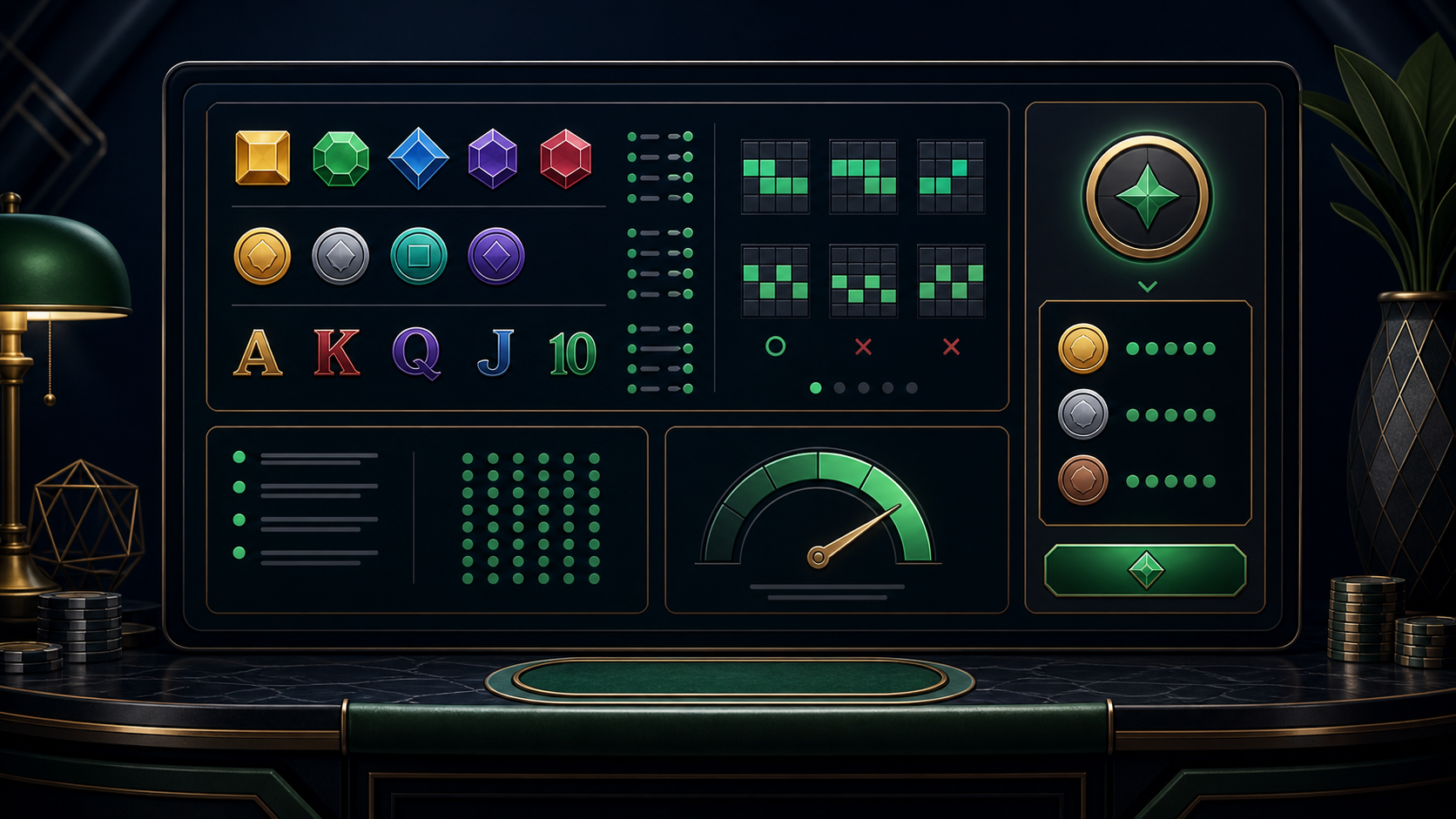
A slot paytable is the game’s rulebook, not a prediction engine. It explains which symbols pay, how wins are formed, what activates a feature and which mathematical configuration is running. Reading it before staking money reduces avoidable confusion, but it cannot tell you what the next spin will produce.
Start with the win system
Do not assume every slot uses fixed paylines. Modern games may use paylines, ways to win, adjacent pays, cluster pays or scatter pays. A payline normally requires matching symbols on a defined path. A ways game usually pays matching symbols on consecutive reels from the left, regardless of their row. Cluster games typically require a minimum group of matching symbols touching horizontally or vertically. The information screen should state the exact rule.
| System | What to verify | Common mistake |
|---|---|---|
| Paylines | Number, direction and whether all lines are active | Assuming any visible match pays |
| Ways | Required consecutive reels and starting reel | Treating ways as fixed lines |
| Clusters | Minimum cluster size and connection rule | Counting diagonal symbols when diagonals do not qualify |
| Scatter pays | Required count and eligible reel area | Assuming position never matters |
Read symbol values in stake units
Paytables often express awards as multiples of the total bet. A 5x award at a 1-unit stake is 5 units; it is not a five-unit profit if other spins have already been played. Check whether values apply to the total stake, coin value, line stake or a separate feature bet. Jackpot-style labels may also represent fixed multiples rather than progressive prizes.
Wild, scatter, money and collect symbols usually follow different rules. A wild may substitute only for regular symbols. A scatter can trigger a bonus without forming a normal win. Money symbols may need a collect symbol to become payable. Read each symbol entry separately instead of inferring behaviour from its artwork.
Separate feature conditions from feature frequency
“Three scatters trigger free spins” describes a condition, not how often it happens. Unless the provider publishes a verified trigger frequency, the paytable does not justify estimates about how many spins a feature should take. A long gap does not make a bonus due, and a recent bonus does not prevent another one.
Check RTP and configuration
The same title can be supplied in multiple approved RTP configurations. Verify the percentage inside the live game rather than relying on an old review or promotional page. RTP is a theoretical long-run average across a very large number of plays, not a promise for one session. Volatility describes how unevenly outcomes may be distributed; it does not improve the expected return.
Price optional features correctly
Bonus buys, ante bets and enhanced spins change the stake or access route. A feature priced at 100x costs one hundred times the selected base stake. Paying more for access does not guarantee that the feature returns its purchase price. Check whether the option changes RTP, disables another feature, uses a different reel set or is unavailable in your jurisdiction.
- Confirm the total amount before activating any paid feature.
- Do not increase stake to recover a poor bonus result.
- Include feature purchases in the same fixed session budget.
- Stop when the planned money or time limit is reached.
A 60-second pre-play check
- Identify the win system and required symbol positions.
- Confirm what wilds, scatters, money and collect symbols actually do.
- Check the active RTP version and stated volatility.
- Read feature triggers, retrigger rules and maximum limits.
- Convert optional feature prices into the real amount at your stake.
CasinOK Casino provides access to its current game catalogue, while the slots section lets you browse available titles. The UK Gambling Commission’s RTS 3 guidance requires rules and information about the likelihood of winning to be available and understandable.
Bottom line
A paytable helps you understand a game’s rules, costs and mathematical disclosures. It does not identify a winning moment. Use it to avoid rule mistakes, verify the exact configuration and set limits that do not depend on recovering previous losses.