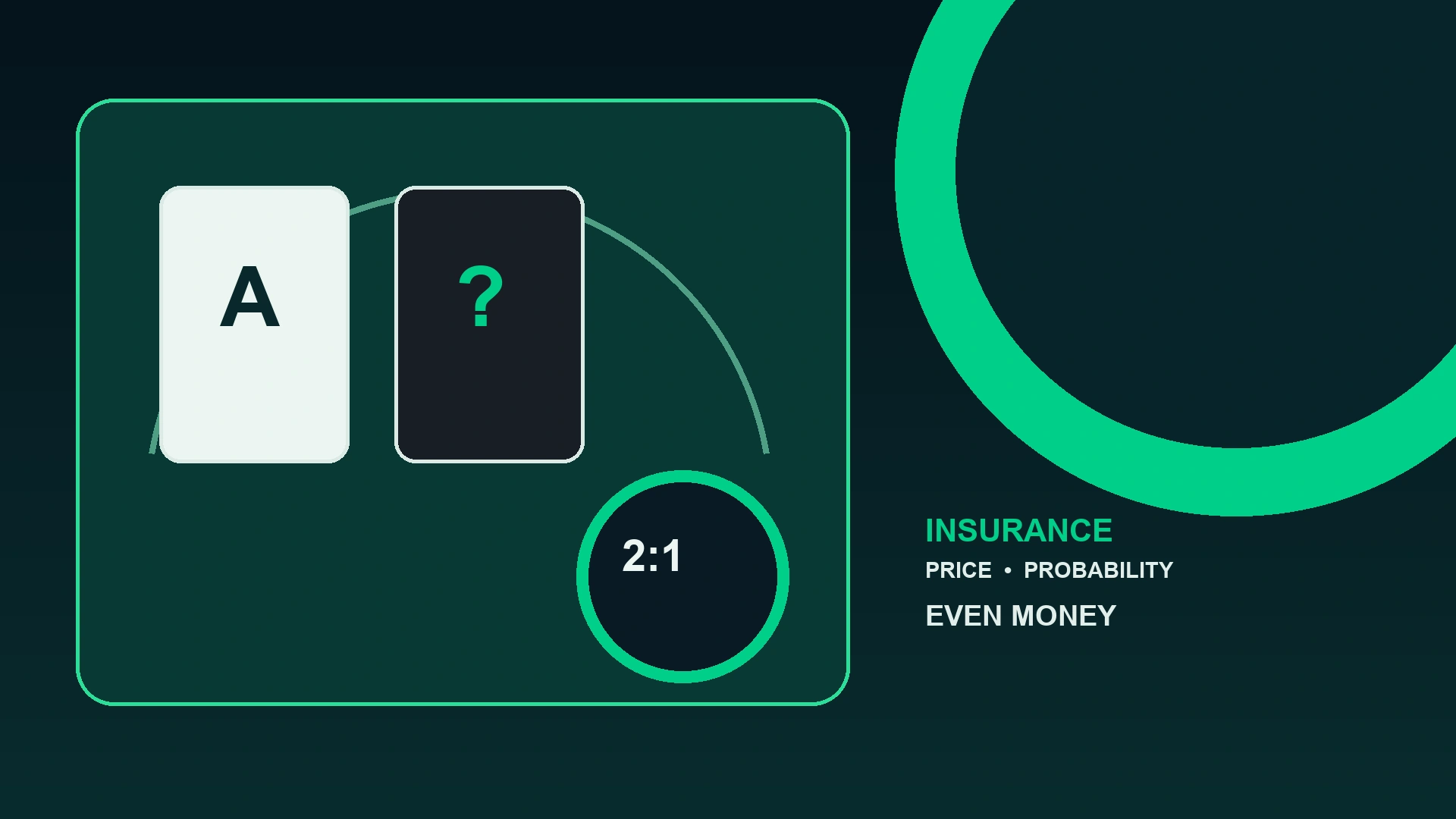
Blackjack insurance appears at a tense moment: the dealer shows an ace and offers a separate wager against the possibility of blackjack. The name sounds protective, but it does not insure the original hand in the ordinary sense. It is a side bet on whether the dealer's hidden card is worth ten. The correct way to assess it is to compare the price, payout and probability—not to ask whether the main hand feels too valuable to lose.
How the insurance wager works
When the dealer's upcard is an ace, a standard table may allow insurance of up to half the original stake. If the hidden card is a ten, jack, queen or king, insurance normally pays 2:1. If it is any other rank, the insurance stake loses and the original hand continues under the table rules.
| Original stake | Maximum insurance | Insurance result if dealer has blackjack | Result if dealer does not |
|---|---|---|---|
| 10 units | 5 units | 10-unit profit plus 5-unit stake returned | 5-unit insurance stake lost |
| 20 units | 10 units | 20-unit profit plus 10-unit stake returned | 10-unit insurance stake lost |
The original blackjack wager and the insurance wager settle separately. A player can lose the main hand and win insurance, or lose insurance and then win, push or lose the main hand. Combining the two results for convenience does not make them one mathematical bet.
The break-even probability
A 2:1 payout breaks even only when the winning event occurs one time in three. Imagine three equal insurance wagers: one win produces two units of profit, while two losses cost two units. Below a 33.33% chance of a ten-value hidden card, the wager has negative expected value.
In a fresh standard deck, 16 of 52 cards have a value of ten. After the visible ace is removed, 16 of 51 unseen cards are ten-value cards, about 31.37%. In multi-deck games the precise starting percentage is slightly different, but it remains below one third. The gap between the break-even rate and the actual composition creates the house edge.
| Measure | Approximate value | Meaning |
|---|---|---|
| Break-even rate at 2:1 | 33.33% | Required probability for zero expectation |
| Fresh single-deck rate after visible ace | 31.37% | 16 ten-value cards among 51 unseen cards |
| Difference | 1.96 percentage points | Why the standard offer is unfavourable before composition changes |
Expected-value example
Using the simplified single-deck starting composition, a one-unit insurance stake wins two units with probability 16/51 and loses one unit with probability 35/51. Its expected result is therefore (16/51 × 2) minus (35/51 × 1), or −3/51: about −0.0588 units per unit wagered. That corresponds to a house edge of roughly 5.88% on the insurance stake in this example.
This is a long-run average, not a forecast for one deal. Insurance can win immediately. A winning outcome does not change the price of the wager or prove that it was favourable.
Even money is insurance in another form
When a player has a natural blackjack and the dealer shows an ace, the table may offer “even money.” Accepting it pays the hand at 1:1 immediately. Declining it usually means the blackjack pays its normal rate if the dealer does not also have blackjack and pushes if the dealer does.
At a 3:2 blackjack table, even money is mathematically equivalent to taking the maximum insurance wager. With a 10-unit blackjack, the player can accept a guaranteed 10-unit profit. Alternatively, a 5-unit insurance wager pays 10 units when the dealer has blackjack, offsetting the push on the main hand; when the dealer does not, the 15-unit blackjack profit minus the 5-unit insurance loss again leaves 10 units.
The guarantee removes short-term uncertainty but does so at an unfavourable standard price. A calmer-feeling result is not automatically a better expected result.
What about cards already seen?
The proportion of ten-value cards among the unseen cards can change during play. In theory, insurance becomes favourable when more than one third of the unseen cards are ten-value cards. Calculating that threshold explains the mathematics, but casual visual impressions are unreliable, and online shuffling systems, continuous shufflers and house procedures can make past cards irrelevant or unavailable.
This guide does not present card counting as a guaranteed or operational strategy. Table rules, deck handling and local policies vary, and no observation changes the need for a fixed entertainment budget.
Common decision errors
- Protecting a large stake: the original stake's size does not improve the side bet's odds.
- Reacting to a streak: several dealer blackjacks do not make the next hidden card “due” to be safe or dangerous.
- Confusing volatility with value: even money is smoother, but its expected return is lower under ordinary composition.
- Ignoring table payout: a 6:5 blackjack table changes the comparison and should be evaluated from its displayed rules.
- Chasing the insurance loss: increasing the next wager cannot recover value already lost.
A practical checklist
Read the table's blackjack payout and insurance terms before staking. Treat insurance as a new wager, calculate it against a one-in-three break-even point, and decide within a pre-set session limit. The broader blackjack basic-strategy guide explains why rule variations must be checked before applying any chart.
For most players without reliable composition information, declining standard insurance and even money is the probability-consistent decision. That does not guarantee a better result in the next hand; it avoids repeatedly buying a side bet priced above its ordinary probability.
Bottom line
Insurance is a wager that the dealer's hidden card is ten-valued. A 2:1 payout needs a probability above 33.33% to be favourable, while a fresh shoe normally begins below that threshold. Even money packages the same trade-off as a guaranteed 1:1 blackjack return. CasinOK Casino treats both choices as probability questions, not protection products. Set money and time limits first, and use the site's responsible-gaming guidance as the boundary for any play.